Chemical Composition of Smoke

Q(Lab) :  I'm looking for information on what the combustion products are for each type of combustible, can you help me? A(ChatGPT) :  Sure, I can help you with that. However, the combustion products depend on the type of combustible being burned. Here are the common types of combustibles and their combustion products: Hydrocarbons (such as natural gas, propane, gasoline, and diesel fuel) - The combustion products of hydrocarbons are water vapor (H2O) and carbon dioxide (CO2), along with other gases such as carbon monoxide (CO) and nitrogen oxides (NOx) that are produced depending on the combustion conditions. Biomass (such as wood, charcoal, and agricultural waste) - The combustion products of biomass are primarily water vapor (H2O), carbon dioxide (CO2), carbon monoxide (CO), and small amounts of other gases like nitrogen oxides (NOx) and sulfur dioxide (SO2). Coal - The combustion products of coal depend on the type of coal being burned, as well as the combustion conditions...

Temperature Prediction and Pressurization Design for Vertical Shaft

​ Predict vertical shaft temperature just before a fire starts * Vertical shaft temperature variable - Weather factors: ambient temperature, wind, sun position - Architectural factors: location of the vertical shaft in the building (center, edge), leakage characteristics of the vertical shaft, insulation characteristics of the building - Thermal factors: outside air entering the building, heating load, cooling load, people, thermo-equipments * Vertical shaft temperature prediction method - Option 1: Using EnergyPlus program, https://blog.naver.com/hbscd/222929116510 - Option 2: Reflect the contents of EN 12101-13 (2022), clause 8.2.2 in the domestic TAB procedure --> Reflect the temperature of buildings of similar use and scale Prediction of temperature according to pressurization of vertical shaft after fire * Vertical wind temperature variable - Weather factors: outside air temperature, wind, sun position - Architectural factors: location of the vertical sh...

Set weather conditions (Ambient temperature, barometric pressure, wind)

  A. Long-term worst case Ambient conditions (a compromise between 25 years of weather and the most recent weather data) :  See Handbook of smoke control engineering (2012), p.94 or ASHRAE Handbook Fundamentals Table 2.1 & 2.2 B. Yearly Weather and 1/10/20/50 Year Worst Temperature :  ASHRAE climatic design conditions 2009/2013/2017/2021 (ashrae-meteo.info) C. HR(Humidity Ratio) to RH(Relative Humidity) :  meteorology - How do I convert specific humidity to relative humidity? - Earth Science Stack Exchange D. Weather in the past :  https://www.timeanddate.com/weather/@1838532/historic * Back to Main Procedures :  General COMTAM Simulation Procedure for Pressure differential system(Mainly High-rise building) (contamsmulationlab.blogspot.com)

Understanding Fans

이미지
 Flow rate (Flow rate = flow rate of liquid and gas, air volume = flow rate of gas)  * Type of flow rate (air volume): Mass flow rate (kg/sec), Volume flow rate (㎥/sec), Mass flow rate = density x volume flow rate. * Type of flow load (Figure 1, Source- https://www.nationalpolyindustries.com.au/2018/06/14/understanding-water-pump-rated-maximum-and-normal-flow-rates/ )     - Maximum flow rate: The maximum flow rate that can be conveyed without connecting a duct system to the fluid machine.      - Rated flow rate: Flow rate considered in design for fluid machine selection (design maximum load flow rate) --> Specific altitude, maximum airflow condition (maximum door opening condition in case of fire)      - Normal flow rate: The flow rate that the fluid machine is expected to operate for the longest period of time --> Specific altitude, normal flow condition (All doors closed in case of fire?)  Fans * Fan = a machine that transpo...

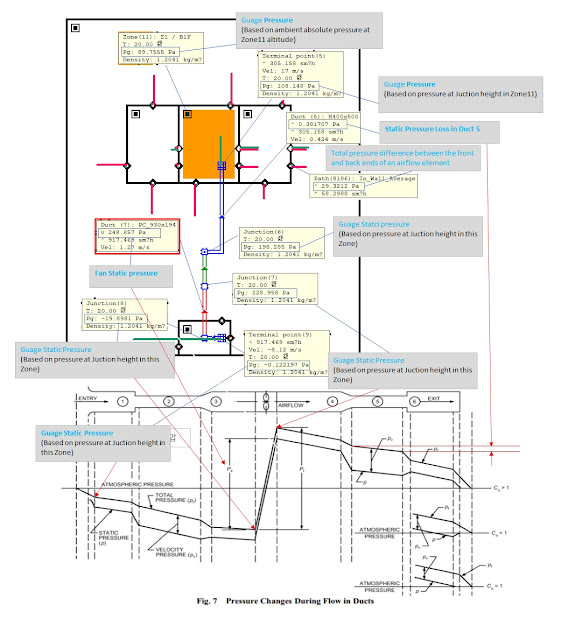
Precise meanings of elemental pressures in CONTAM

이미지
* Static pressure(Ps) : pressure caused by a greater or lesser number of gases per unit volume. * Dynamic pressure(Pd) : Pressure caused by the density and velocity of the gas. * Total pressure(Pt) : Static pressure + dynamic pressure * Static pressure differen ce( △Ps)  : Ps2 - Ps1 * Total pressure difference( △Pt)  : Pt2 -Pt1 * Back to Main Procedures :  General COMTAM Simulation Procedure for Pressure differential system(Mainly High-rise building) (contamsmulationlab.blogspot.com)

Electricity and Fluids (CONTAM Elementalization of Dampers)

이미지
1. Electrical   - V=IR   - R=ρL/A 2. Fluid   - Q=vA   - △P=ζ × Pd=ζ × 0.5ρv^2=ζ × 0.5ρ(Q/A)^2=(ζρ/A^2) × Q^2   - △P=R'Q^2 (R'=ζρ/A^2) 3. Electricity and fluids   - △P=R'Q^2   - V=IR   - V ≒ △P   - I ≒ Q^2   - R(ρL/A)≒ R'(ζρ/A^2) 4. CONTAM elementrization of the damper   - R' = ζρ/A^2     - Real: A=variable, ζ=variable   - CONTAM : Based on the performance test results (Q, △P, R') and full open cross-sectional area (A) of a specific damper --> Extract the maximum and minimum values of Terminal loss coefficient (ζ) to apply to the CONTAM program of a specific damper. * Back to Main Procedures :  General COMTAM Simulation Procedure for Pressure differential system(Mainly High-rise building) (contamsmulationlab.blogspot.com)

The 3 Principles of Flame Retardant Leakage (Leakage Laws)

이미지
  1. Leakage ratio of major leakage elements Floor:Wall:Window area with leakage gap area equivalent to one fire door (Single Door) ≈ 450:150:50   - Floor-Average concrete floor area of a fire safety standard fire door = about 450m^2   - Wall-Average area of fire safety standard fire door = approx. 150m^2   - Fire safety standard equivalent window (grade 3) area = about 50m^2 (KS fire door equivalent window area = about 30m^2) 2. Leakage path - Basement floor   - Ground floor 3. The 3 Main Principles of  Leak elements of  Smoke control system  - Principle 1 (Volume flow rate Principle): The air volume of a supply air pressure fire extinguishing system is governed by the number of floors open to fire, the size of the door, and the sum of the leakage area of the smallest leakage element and the parallel leakage elements on the leakage path of each floor.    - Principle 2 (Differential Pressure Principle): The differential pressure of a spe...